In economics it is very rare to achieve all seven of the macroeconomic objectives (positive and sustained growth, low levels of inflation, low unemployment, the 'satisfactory' balance on the current account of the balance of payments, a low level of government borrowing, exchange rate stability, an equitable distribution of income and wealth and long run environmental sustainability).
Unintended consequences of government policies can adversely affect macroeconomic indicators other than the targeted indicator. Therefore it may be necessary for governments to evaluate the trade off between conflicting economic objectives and deciding which is the greatest priority. The decision made will depend on a variety of factors including the economic development, position on the PPF and the political party in government.
Positive economic growth occurs when real output (GDP) increases over time, but for it to be sustainable economic growth the rate of growth must be maintained in the long run without creating other significant economic problems, this is typically achieved in the long run through the use of supply-side policies to stimulate supply lead growth.
Inflation is a constant or persistent increase in the general price level or a decrease in the value of the pound. In the UK the target inflation rate is 2% CPI, low and stable inflation over many years is desirable because it is relatively easy to anticipate next year's inflation rat. It may also make labour markets function efficiently because even if the average wage is rising there will still be some peoples wages which will fall to maintain a low level of unemployment in the economy.
Conflicts with Demand-Pull Inflation
Using the Keynesian aggregate supply schedule to the right it is clear that when there is spare capacity in an economy a increase in one ore more of the components of aggregate demand (C, I, G, [X-M]) would result in a right would shift of AD1 to AD2, resulting in positive sustainable growth from Y1 to Y2 and low inflation from P1 to P2. But if there is a rightward shift of aggregate demand when the economy is near to full capacity, shown the shift of AD3 to AD4, there is no economic growth, the economy is still producing at Y3 but the general price level has drastically increased from P3 to P4, which is unsustainable due to the inflationary pressure on the economy. The risk of the accelerating inflation is greater in the short run when aggregate when aggregate supply is inelastic as there is low spare capacity.

Conflicts with Cost-Push Inflation
Cost-push inflation can occur if there is a increase in the costs of production. A main commodity which may cause cost-push inflation as a in rise in the price of imported oil. Firms pass the rise in the costs of production onto the consumers via a rise in the price. This causes a shift of aggregate supply to the left from AS to AS1, resulting in a rise in the general price level from P to P1, causing inflation. But at the same time resulting in a decline in real national output from Y to Y1. This is low inflation but negative economic growth, causing conflicts in the macroeconomics objectives.
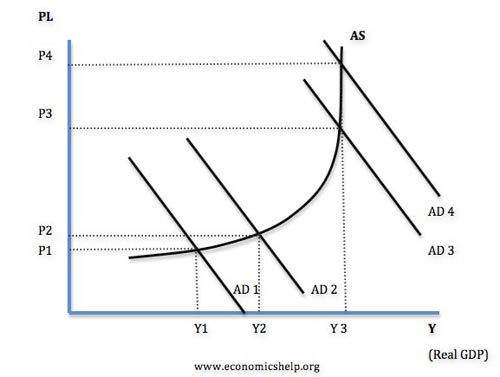 |
| A Keynesian Aggregate Supply Schedule |
Conflicts with Cost-Push Inflation
Cost-push inflation can occur if there is a increase in the costs of production. A main commodity which may cause cost-push inflation as a in rise in the price of imported oil. Firms pass the rise in the costs of production onto the consumers via a rise in the price. This causes a shift of aggregate supply to the left from AS to AS1, resulting in a rise in the general price level from P to P1, causing inflation. But at the same time resulting in a decline in real national output from Y to Y1. This is low inflation but negative economic growth, causing conflicts in the macroeconomics objectives.

No comments:
Post a Comment